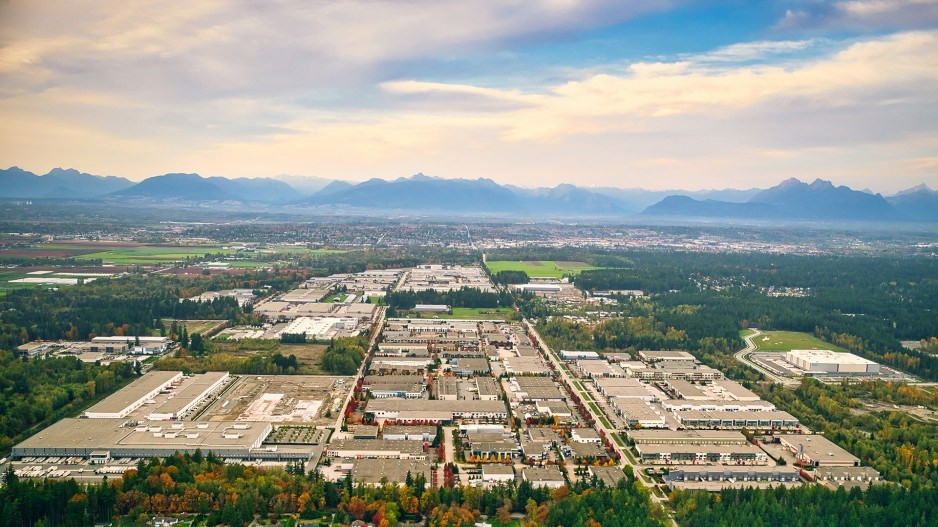
Campbell Heights occupies a unique position in Metro Vancouver's industrial landscape. Situated in South Surrey near the Canada-U.S. border, the business park has evolved from speculative farmland rezoning into one of the region's most purposefully planned employment areas. For owners, occupiers, and investors evaluating industrial opportunities in 2026, Campbell Heights warrants close examination, not as a frontier market, but as a maturing submarket with distinct characteristics that differentiate it from older industrial nodes.
Geographic Context and Strategic Location
Campbell Heights spans approximately 1,200 acres in South Surrey, bounded roughly by 16 Avenue to the south, 24 Avenue to the north, 184 Street to the west, and 196 Street to the east. The park's proximity to the Pacific Highway border crossing (less than five kilometres away) has historically attracted cross-border logistics operators and customs brokers. Highway 99 and Highway 15 (176 Street) provide north-south connectivity to Richmond, Delta, and the U.S. border, while the planned improvements to 32 Avenue are expected to enhance east-west access to Langley and Highway 1.
Unlike Vancouver's older industrial districts, which developed organically around port and rail infrastructure, Campbell Heights was master-planned by the City of Surrey beginning in the early 2000s. This planning legacy is visible in the park's wide arterials, generous setbacks, contemporary building stock, and separation between light industrial, business park, and heavier industrial uses.
Building Inventory and Tenant Composition
Campbell Heights contains approximately 8 to 9 million square feet of industrial and business park space, with the majority constructed after 2005. Building quality skews toward Class A and Class B product, with clear heights typically ranging from 24 to 32 feet in newer distribution facilities. Strata subdivisions are common, particularly in the southern portions of the park, offering units from 3,000 to 15,000 square feet suited to small and mid-sized owner-users.
The tenant base reflects the park's positioning as a logistics and light manufacturing hub:
- Third-party logistics providers serving cross-border and regional distribution networks
- Food and beverage processors drawn by the park's modern facilities and proximity to agricultural land
- Building materials and construction supply distributors serving the Fraser Valley's residential growth
- E-commerce fulfillment operators requiring access to South Surrey and White Rock populations
- Light manufacturers in sectors such as millwork, fabrication, and specialty products
Notably, Campbell Heights has attracted several headquarters and regional offices for companies that combine warehousing with administrative functions. The business park zoning in certain areas permits higher office-to-warehouse ratios than traditional industrial zones, accommodating these hybrid uses.
Lease Rates and Transaction Activity
As of mid-2026, asking lease rates in Campbell Heights generally range from $18 to $23 per square foot net for warehouse and distribution space, with newer Class A product and smaller strata bays commanding the upper end. These rates position Campbell Heights between the premium pricing of Richmond and Vancouver-proper industrial and the more moderate rates found in Langley's newer developments further east.
Several factors support Campbell Heights' relative rate stability:
- Limited new supply: The park is largely built out, with remaining developable parcels constrained by Agricultural Land Reserve boundaries and infrastructure sequencing. New construction has slowed compared to the 2018-2022 period.
- Functional building stock: Modern clear heights, efficient truck courts, and adequate power capacity make existing buildings competitive without requiring substantial tenant improvements.
- Border proximity: Cross-border operators face few viable alternatives with comparable U.S. access, supporting occupancy even during softer demand periods.
Strata industrial sales have remained active, with owner-users competing for units in the $450 to $550 per square foot range depending on size, ceiling height, and office finish. Investor demand has been more selective, reflecting broader caution around industrial cap rates and interest rate uncertainty.
Infrastructure and Municipal Considerations
Surrey's ongoing investment in Campbell Heights infrastructure has been a defining feature of the submarket's development. The 32 Avenue widening project, now advancing through design and land acquisition phases, will ultimately provide a direct arterial connection to Highway 1 via 196 Street, reducing travel times to Langley, the Fraser Valley, and the broader provincial highway network. For occupiers reliant on truck movements, this connectivity improvement is significant.
Municipal servicing in Campbell Heights is generally robust, though power capacity deserves attention. Manufacturing tenants with heavy electrical loads should verify BC Hydro service availability during due diligence, as some older portions of the park were designed for lighter commercial uses. The City of Surrey has been receptive to infrastructure upgrades that support employment density, but lead times for new service connections can extend beyond typical lease negotiation timelines.
Zoning in Campbell Heights falls primarily under Surrey's Business Park (IB) and Light Impact Industrial (IL) designations, with specific areas permitting higher office ratios. Prospective tenants should confirm permitted uses carefully, as the business park zones impose restrictions on outdoor storage, heavy manufacturing, and certain logistics activities that would be permitted in traditional industrial zones elsewhere in Surrey.
Competitive Positioning Within Metro Vancouver
Campbell Heights competes most directly with three adjacent submarkets: Port Kells to the northeast, Langley's industrial corridor along the 200 Street axis, and Delta North near Nordel and Tilbury. Each offers trade-offs relevant to different occupier profiles.
Port Kells provides larger contiguous parcels and heavier industrial zoning, making it better suited to manufacturing and outdoor storage uses. Langley's newer developments along Highway 1 offer competitive rates and modern product but sacrifice border proximity. Delta North provides rail access and port adjacency that Campbell Heights lacks.
For occupiers prioritizing building quality, cross-border access, and a professional business park environment, Campbell Heights remains compelling. The submarket's planning discipline (consistent setbacks, landscaping standards, and separation of uses) appeals to tenants whose operations involve customer-facing or administrative components alongside warehousing.
Outlook and Practical Considerations
Campbell Heights has transitioned from a growth-phase submarket to a mature one. The build-out of developable land means future supply will come primarily from redevelopment of underutilized sites or selective densification, neither of which will meaningfully alter the park's inventory in the near term. For occupiers, this supply constraint supports lease rate stability but limits options for tenants requiring large contiguous footprints.
Investors evaluating Campbell Heights should weigh the submarket's functional advantages against its lack of rail access and distance from port terminals. For logistics strategies centred on last-mile delivery or cross-border distribution, these limitations may be acceptable. For users dependent on intermodal connections, alternative submarkets warrant consideration.
Occupiers exploring Campbell Heights should begin with a clear understanding of their operational requirements (power capacity, zoning permissions, truck access, and proximity to labour pools) and test those requirements against specific buildings rather than assuming the park's modern appearance guarantees compatibility. NAI Commercial Vancouver maintains detailed inventory data on Campbell Heights and can assist with site-specific due diligence as part of a broader Metro Vancouver search.
Campbell Heights represents one of several distinct industrial nodes in the region, each with characteristics suited to particular business models. Understanding those distinctions is the foundation of sound real estate decisions.