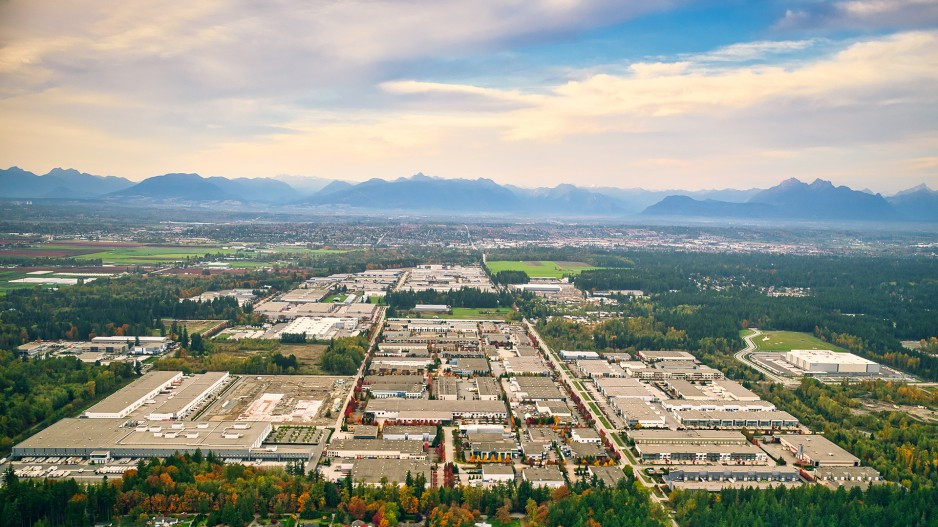
Campbell Heights has dominated Surrey's industrial narrative for the better part of a decade. The business park's master-planned infrastructure, proximity to the U.S. border, and modern building stock made it the default choice for logistics operators, manufacturers, and food processors seeking large-format space in Metro Vancouver's southeast quadrant. But as of September 2026, that narrative is evolving. With Campbell Heights approaching practical build-out and remaining development parcels commanding premium land values, absorption patterns are shifting northward to Port Kells—a submarket that offers different trade-offs but increasingly compelling economics.
For owners, occupiers, and investors evaluating Surrey industrial opportunities, understanding how these two nodes interact is now essential to informed decision-making.
Campbell Heights: Absorption Constrained by Finite Land
Campbell Heights delivered a large wave of new industrial space between 2018 and 2025, transforming former agricultural land into one of Metro Vancouver's most modern industrial concentrations. The business park attracted anchor tenants including Amazon, Loblaws, and various cold storage operators, establishing rental benchmarks for Class A warehouse and distribution space that sit above the Surrey average of about $18.66 PSF net recorded in Q2 2026, though down from their 2023 peak.
However, the land supply that fueled this growth is largely exhausted. As of mid-2026, few development-ready parcels remain, most controlled by developers with projects already in pre-leasing or construction. The City of Surrey's phased servicing approach—which extended municipal infrastructure south in planned increments—has reached its current boundary. While the 32 Avenue widening project will eventually open additional land to the south, that supply remains years away from practical availability.
The result is a submarket where absorption has slowed partly because there is less new product to absorb. Node-level vacancy is not published, but Surrey as a whole averaged about 3.8% vacancy and 5.0% availability in Q2 2026, below the regional 4.3%, and lease rates have eased from their 2023 peak rather than climbing. For occupiers requiring 50,000 square feet or more of modern distribution space, Campbell Heights increasingly presents a timing problem: the right building may not be available when their lease expires or their operational needs change.
Port Kells: The Spillover Beneficiary
Port Kells occupies a distinct position in Surrey's industrial geography. Located roughly 12 kilometres north of Campbell Heights, the submarket straddles the Fraser Highway corridor and benefits from direct access to Highway 1 via 176 Street. The building stock is more varied than Campbell Heights—a mix of 1980s and 1990s construction alongside newer infill developments—but functional clear heights of 24 to 28 feet remain common, and many properties offer the yard storage and trailer parking that modern logistics operations require.
Absorption in Port Kells accelerated through 2025 and into 2026 as tenants priced out of Campbell Heights sought alternatives. Net asking rates in Port Kells for functional warehouse space generally sit at or below the Surrey average of about $18.66 PSF net in Q2 2026, representing a discount relative to Campbell Heights Class A product. For operators where proximity to the border crossing is not mission-critical, this differential translates directly to occupancy cost savings.
The submarket has accounted for a meaningful share of Surrey's positive absorption over the past 18 months, much of it from tenants who initially targeted Campbell Heights but pivoted when suitable options proved unavailable or uneconomical. Food and beverage distributors, building materials suppliers, and regional logistics providers have been particularly active, drawn by Port Kells' combination of functional space, competitive rates, and highway accessibility.
Comparative Advantages and Trade-Offs
Choosing between Campbell Heights and Port Kells involves weighing several operational and financial factors:
- Building Quality: Campbell Heights offers predominantly Class A product with 32-foot-plus clear heights, ESFR sprinkler systems, and modern loading configurations. Port Kells presents a wider quality spectrum, requiring more careful due diligence on building condition and functional suitability.
- Transportation Access: Campbell Heights provides faster access to the Pacific Highway border crossing, making it preferable for cross-border logistics. Port Kells offers superior Highway 1 connectivity for operations serving the broader Lower Mainland or Fraser Valley.
- Lease Economics: The rate differential between submarkets compounds significantly on larger footprints. On a 75,000 square foot requirement, every $1.00 PSF of difference is worth $75,000 annually, so even a modest spread between Port Kells and Campbell Heights Class A space adds up over a term.
- Labour Access: Both submarkets draw from Surrey's substantial industrial workforce, though Port Kells' proximity to Langley and Maple Ridge may offer advantages for operations requiring specialized trades.
- Expansion Flexibility: Port Kells' fragmented ownership and varied building stock can make expansion within the submarket easier to execute, whereas Campbell Heights' institutional ownership tends toward longer-term holds with less flexibility for adjacent expansion.
Investment Implications
The absorption shift carries meaningful implications for industrial investors. Campbell Heights assets price close to the roughly 4.4% regional average that Lee & Associates reported for Q2 2026, reflecting institutional-grade tenancy and modern building specifications. Port Kells trades at wider spreads but offers value-add potential through lease-up, renovation, or redevelopment of older stock.
Investors should note that Port Kells' zoning and lot configurations vary more than Campbell Heights' master-planned parcels. Some properties carry legacy zoning that permits a broader range of uses, potentially supporting higher-and-better-use analyses. Others face constraints around outdoor storage, truck traffic, or environmental considerations that require careful underwriting.
The spillover dynamic also suggests that Port Kells' rate discount may narrow over time. As Campbell Heights reaches effective build-out and tenants continue migrating north, large-bay options in Port Kells will tighten first, even with regional rents down 4% to 6% year over year and about 3.0 million square feet under construction across Metro Vancouver. Early movers—whether tenants securing favourable lease terms or investors acquiring well-positioned assets—stand to benefit from this compression.
What This Means for Occupiers
For tenants actively seeking space in Surrey, the Campbell Heights-Port Kells dynamic demands a broader search radius than many initially anticipate. The instinct to focus exclusively on Campbell Heights—driven by its visibility and brand recognition—can result in missed opportunities and compressed timelines.
A more effective approach involves parallel evaluation of both submarkets, benchmarking available options against operational requirements rather than submarket prestige. Questions to consider include:
- What percentage of inbound and outbound freight crosses the U.S. border versus serves domestic markets?
- What clear height and loading configurations are genuinely required versus preferred?
- How do labour recruitment patterns align with each submarket's geographic position?
- What lease term flexibility exists, and how does this interact with rate differentials?
Tenants who answer these questions honestly often find that Port Kells meets operational requirements at materially lower cost, freeing capital for equipment, inventory, or other business investments.
A Market in Transition
Surrey's industrial market is not static. The absorption patterns observed through 2025 and 2026 reflect a structural shift as Campbell Heights transitions from growth phase to stabilization, and Port Kells emerges as the submarket absorbing incremental demand. This transition will continue as the 32 Avenue corridor eventually opens new Campbell Heights supply, but that timeline extends well beyond most current lease decision horizons.
For owners, occupiers, and investors navigating Surrey industrial opportunities, the key takeaway is straightforward: Campbell Heights remains a premier submarket, but it is no longer the only option worth serious consideration. Port Kells offers functional space, competitive economics, and improving fundamentals. Understanding how these two nodes interact—and how absorption patterns continue to evolve—provides the foundation for informed real estate decisions in Metro Vancouver's most dynamic industrial corridor.