Delta's industrial market has long operated in the shadow of its more prominent neighbours: Richmond to the north and Surrey to the east. But a convergence of infrastructure investment, constrained land supply, and strategic energy development is repositioning this South Fraser submarket as one of Metro Vancouver's most consequential industrial corridors. At the centre of this transformation sits the Tilbury LNG facility and the broader energy and logistics ecosystem emerging around it.
Understanding the Tilbury LNG Expansion
FortisBC's Tilbury LNG facility, located on the Fraser River in Delta, has operated since 1971 as a peak shaving and storage facility. The current expansion program represents a fundamental shift in scale and strategic importance. The Tilbury Phase 2 LNG Expansion remains under provincial environmental assessment with a decision anticipated in late 2026, while the separate Phase 1B expansion received a provincial order in council in July 2026 that lets it proceed toward construction as early as mid-2027 (Province of B.C., July 24, 2026). Together they would significantly increase liquefaction and storage capacity, positioning the facility as a major LNG export and marine bunkering hub for the Pacific Northwest.
The expansion includes new liquefaction trains, additional storage tanks, and enhanced marine loading infrastructure capable of serving LNG-powered vessels. This positions Tilbury as a critical node in the emerging LNG marine fuel supply chain, a market expected to grow substantially as shipping companies transition away from heavy fuel oil to meet International Maritime Organization emissions targets.
For industrial real estate stakeholders, the implications extend well beyond the facility footprint itself. Large-scale energy infrastructure creates demand for supporting industrial uses: equipment staging, maintenance facilities, specialized fabrication, workforce accommodation during construction phases, and ongoing operational support services.
Delta's Industrial Inventory and Current Market Conditions
Delta's industrial inventory is concentrated in three distinct nodes: Tilbury, Annacis Island, and the emerging Deltaport Way corridor. Combined, Delta's industrial inventory runs roughly 29 to 35 million square feet depending on the Q2 2026 brokerage report, with Tilbury and Annacis Island accounting for the majority of older, functional product while newer development has gravitated toward the Highway 17 corridor.
Net asking rents in Delta averaged about $17.91 per square foot across the Q2 2026 brokerage reports for standard warehouse and distribution space, with newer construction commanding premiums above that average. This positions Delta competitively against Surrey (about $18.66 PSF) and below Richmond (about $20.26 PSF) and Vancouver (about $20.10 PSF).
Vacancy in Delta averaged about 4.7% across the Q2 2026 brokerage reports, with availability near 6.3%, slightly above the regional average of 4.3% and well above the sub-1% lows of 2022. Smaller units have loosened the most, while the challenge for tenants seeking larger footprints, particularly those requiring 50,000 square feet or more, is that functional options remain limited, with only about 17 blocks over 100,000 square feet available region-wide.
Infrastructure Drivers Beyond LNG
While the Tilbury LNG expansion commands headlines, Delta's industrial outlook is supported by a broader infrastructure investment cycle that extends beyond energy development.
Deltaport Terminal Expansion: The Roberts Bank Terminal 2 project, though subject to ongoing regulatory and approval processes, would add significant container handling capacity to Metro Vancouver's port infrastructure. Regardless of timing, the long-term trajectory points toward increased logistics activity in the South Fraser corridor.
Highway 99 Tunnel Replacement: The George Massey crossing replacement project, proceeding as an eight-lane immersed-tube tunnel with major construction now expected to begin in 2027 according to provincial project updates in 2026, will dramatically improve connectivity between Delta and Richmond. For industrial occupiers and investors, improved highway access translates directly to operational efficiency and expanded labour market reach.
South Fraser Perimeter Road: Already operational, this corridor has fundamentally improved east-west freight movement between Deltaport and the Highway 1 system. Industrial properties with direct SFPR access command measurable premiums over those dependent on surface arterials.
Collectively, these infrastructure investments are repositioning Delta from a secondary industrial submarket to a primary logistics node with genuine competitive advantages for port-related and distribution uses.
Implications for Industrial Owners
Property owners in the Tilbury and Annacis Island areas face a strategic decision point. Older industrial product, particularly buildings constructed in the 1970s and 1980s with lower clear heights and limited trailer parking, will increasingly compete for tenants against newer purpose-built facilities in Campbell Heights and South Surrey.
However, the constrained land supply and infrastructure investment cycle create a supportive environment for strategic repositioning. Owners of well-located sites may find the highest value realization through redevelopment rather than continued operation of obsolete buildings. Clear heights below 24 feet, insufficient power capacity, and inadequate truck courts are becoming material impediments to lease-up at market rates.
For owners of newer or recently upgraded assets, the market still supports renewals at rates near the Delta average, even though net rents region-wide are down 4% to 6% year over year. Tenants in large, functional buildings have limited relocation options, while small-bay tenants have more choice than at any point since the pre-pandemic period, so leverage now depends heavily on the size and quality of the space.
Considerations for Occupiers and Investors
Industrial occupiers evaluating Delta should weigh several factors specific to this submarket:
- Labour Access: Delta draws workers from Surrey, Ladner, Tsawwassen, and Richmond. The labour catchment is substantial but can be sensitive to transit limitations. Proximity to major arterials and the future Massey crossing will influence workforce recruitment.
- Zoning and Use Restrictions: The Agricultural Land Reserve borders much of Delta's industrial land, constraining expansion options. Occupiers requiring future flexibility should verify zoning capacity and ALR boundaries before committing to sites.
- Flood Plain Considerations: Portions of Tilbury and Annacis Island sit within Fraser River flood plain designations. Insurance costs and building code requirements can vary materially based on specific site elevations and flood mitigation infrastructure.
- Power and Utilities: Energy-intensive users should verify BC Hydro capacity at the site level. The LNG expansion has increased regional power demand, and some older industrial areas face upgrade requirements for high-load applications.
For investors, Delta offers yield premiums relative to Vancouver and Burnaby while participating in the same regional demand drivers. Cap rates for stabilized industrial product in Delta sit modestly above the roughly 4.4% regional average that Lee & Associates reported for Q2 2026, depending on asset quality, lease term, and tenant credit, while comparable product in tighter urban submarkets prices below that average.
The risk-adjusted return profile is compelling for investors willing to accept marginally higher vacancy risk in exchange for stronger going-in yields and capital appreciation potential tied to infrastructure-driven demand growth.
The Corridor's Trajectory
The Tilbury LNG corridor represents a case study in how anchor infrastructure investment can reshape submarket fundamentals. Energy development, port expansion, and highway improvements are converging to create a logistics and industrial ecosystem with genuine competitive advantages within Metro Vancouver.
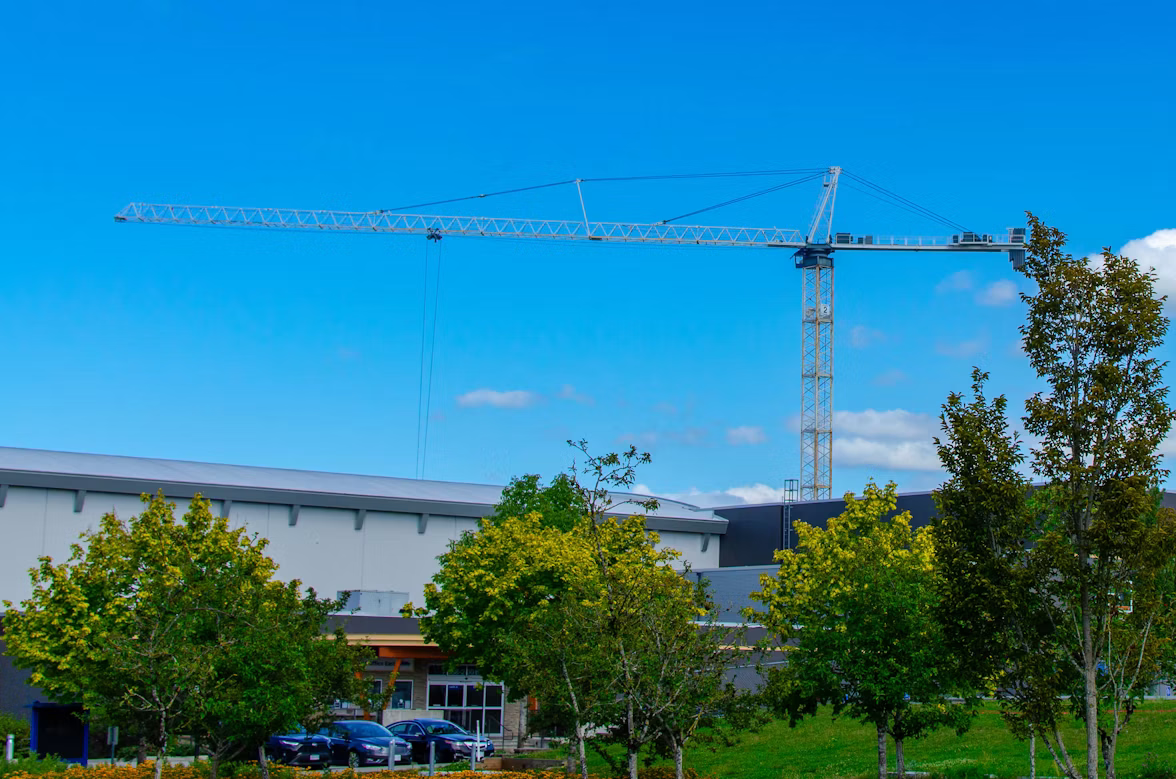
This is not a speculative narrative. Construction cranes are visible at the Tilbury site. Highway planning is advancing. Large-bay supply remains limited even as overall vacancy has loosened. The question for industrial real estate stakeholders is not whether Delta's profile is changing, but how to position portfolios and operations to benefit from that change.
For owners, occupiers, and investors seeking to understand specific opportunities within Delta and the broader South Fraser corridor, NAI Commercial Vancouver maintains active coverage of this submarket through our industrial brokerage team, supported by the research capabilities of the NAI Global network across major North American markets.
The practical takeaway is straightforward: Delta warrants serious consideration in any Metro Vancouver industrial real estate strategy, and the Tilbury corridor specifically merits close attention as infrastructure investment translates into occupier demand and asset value creation over the coming cycle.