On July 23, 2026, the Province of British Columbia opened a consultation on a regulatory change that industrial owners, food manufacturers and anyone tracking land supply in the Lower Mainland should read closely. In short: the government wants to let food processors build processing plants on lower-quality soils inside the Agricultural Land Reserve, without an Agricultural Land Commission exclusion, so long as at least 5% of the primary product run through the plant is grown or raised in B.C.
The update issued August 18, 2026 confirmed the details and set a feedback deadline of September 18, 2026. This post walks through what is actually being proposed, how the numbers work, what approvals would still be required, and what it could mean for the Metro Vancouver industrial market, where food and beverage manufacturing is already one of the largest occupier groups competing for a shrinking pool of buildable land.
What the Province Is Proposing
Today, the ALR Use Regulation permits food processing on ALR land without ALC approval only if at least 50% of the ingredients come from the farm itself (or from fellow member farms of an industry association). Soil quality does not factor into that rule. In practice, that 50% threshold means most processing capacity in the region has been pushed onto conventionally zoned industrial land, which in Metro Vancouver is scarce and expensive.
The proposal would carve out a second pathway. Food processors could build on:
- Class 5, 6 and 7 soils anywhere in the ALR; and
- Class 4 soils, but only where the parcel is already accessible by road and easily connected to existing water, sewer and electrical services on the date the regulation comes into force.
The condition attached to the new pathway is that 5% of the primary product used in the processing must be grown or raised in British Columbia. The existing 50% rule stays in place for all other ALR land, so prime Class 1 to 3 soils are untouched.
Soils are classified for agricultural capability on a scale of 1 to 7, with Class 1 being the most productive. Classes 5 to 7 carry severe limitations for crop production, which is the policy logic here: shift processing onto ground that was never going to be productive farmland, and keep the good dirt for farming.
How Much Land Are We Talking About?
The Province is careful to frame this as a narrow change, and the numbers support that framing:
- The soil-classification filter would exclude roughly 90% of ALR farmland in the Lower Mainland and Fraser Valley.
- The Province estimates 500 to 1,000 hectares could be potentially available for food-processing development regionally.
- A hard cap would limit the total land brought in under the proposal to 0.25% of the more than 2.1 million hectares of privately owned ALR land province-wide, roughly 5,300 hectares at most, across all of B.C.
For context, 500 to 1,000 hectares is somewhere between 1,235 and 2,470 acres. That is not a trivial amount in a region where the ALR is the single biggest structural constraint on industrial land supply and where developable industrial parcels routinely trade at prices that price out manufacturers. But it is also not a flood of new industrial land. This is a targeted release for a single use category, not a rezoning of the Fraser Valley.
Approvals Would Still Be Required
A regulatory permission is not a building permit. Anyone looking to use this pathway would need to clear several gates:
- Soil assessment by a registered professional agrologist confirming the parcel meets the Class 4 to 7 criteria (and, for Class 4, that servicing and road access existed on the effective date).
- Local government building permits and any other municipal approvals. This is the piece to watch. Provincial ALR use rules define what the Commission will not stand in the way of; they do not automatically override municipal zoning. Cities such as Delta, Richmond, Surrey, Langley and Abbotsford will each have their own view on where processing plants belong, and their zoning bylaws would still need to accommodate the use.
- Provincial permits from the Ministry of Water, Land and Resource Stewardship and the Ministry of Environment and Parks where applicable: think water licences, riparian setbacks, drainage and effluent.
Servicing is the practical bottleneck. Class 5 to 7 soils in the Lower Mainland are frequently low-lying, poorly drained or on the fringes of existing service areas. A parcel that qualifies on soil but sits two kilometres from a sewer main is not a development site; it is a long-term hold.
Why This Matters for Industrial Real Estate
Food and beverage manufacturing is the second-largest manufacturing sector in B.C., generating an estimated $14.3 billion in 2024 and employing 37,430 people. The province exported $3.7 billion in processed food and beverage products that year. A large share of that activity happens in Metro Vancouver and the Fraser Valley, in buildings that need heavy power, floor drains, wash-down capability, refrigeration and often cold storage, specifications that are expensive to retrofit into generic warehouse product and hard to find on the market.
Right now, a food processor looking to expand in the region has essentially two options: compete for scarce zoned industrial land against logistics and distribution users who can often pay more per square foot, or leave the region altogether. This proposal opens a third lane, and it does so on land that has historically been valued as farmland rather than industrial.
A few implications worth thinking through:
- Relief valve, not a game changer, for industrial supply. Because the pathway is restricted to food processing, it will not directly add warehouse or distribution capacity. Indirectly, though, every processor that lands on an ALR parcel is one less occupier bidding on conventional industrial land in Delta, Richmond, Langley or Abbotsford. At the margin, that eases pressure.
- A new class of asset. Purpose-built food-processing facilities on ALR land would be a distinct product with a narrower buyer and tenant pool than freehold industrial. Owners and lenders should expect valuation to be use-constrained. The exit is another food processor, not a 3PL.
- Repricing of marginal ALR parcels. Serviced or near-serviced Class 4 to 7 parcels close to existing industrial nodes are the obvious winners. Expect owners of those parcels to start asking questions about their soil classification the moment this looks likely to pass.
- The Class 4 timing clause matters. Class 4 land only qualifies if it is serviced and road-accessible when the regulation takes effect. That creates an incentive to confirm servicing status now rather than later, and it means unserviced Class 4 parcels are permanently out unless the rule changes.
The Open Questions
The discussion paper leaves several issues for the consultation to sort out, and these are the ones I would flag in any submission or client conversation:
- Is 5% enough? Five percent B.C.-grown content is a low bar. It is designed to be attractive to processors, and it will be. The counter-argument from farm groups is predictable: a plant that sources 95% of its inputs from outside the province is an industrial use wearing an agricultural label. Watch for the threshold to move.
- How is “processing” policed? The ALR Use Regulation defines processing as storing, packing, preparing and processing farm products. Storing and packing are the parts of that definition that could blur into distribution. Enforcement and definitions will determine whether this stays a food-processing tool or drifts toward general warehousing.
- Municipal appetite. Local governments have spent decades planning around the ALR boundary. Some will welcome the jobs and tax base; others will resist processing plants in areas they have designated rural. Expect uneven uptake across municipalities.
- Infrastructure cost allocation. If servicing is the constraint, who pays to extend it? Developers will look to municipalities and the Province; municipalities will look to developers.
Timeline and How to Weigh In
The engagement runs for six weeks. Feedback is invited from interested parties until September 18, 2026 by email to AF.Minister@gov.bc.ca. The full discussion paper is available on the BC Gov News release. If your business processes food in the Lower Mainland, or you own ALR land you suspect is Class 4 or lower, this is the window to be heard. Consultations like this one tend to be dominated by farm organizations and local governments; the occupier voice is often underrepresented.
What I Would Do Now
For food and beverage occupiers currently in a lease or planning an expansion, nothing changes today. The proposal is not law, the timeline to a functioning permitting pathway is realistically 12 to 24 months at best, and the number of parcels that will actually pencil is smaller than the headline hectares suggest. Keep your site selection process focused on the zoned industrial inventory that exists, and treat this as an option value rather than a plan.
For owners of ALR land in the Lower Mainland, it is worth pulling your soil classification and confirming servicing status. If you have a Class 4 to 7 parcel near existing services, you may be sitting on something more valuable than farmland pricing implies. That does not mean speculate; it means understand what you own before someone else does.
For investors, this is early. But if the regulation passes in a form close to what has been proposed, purpose-built food-processing facilities on ALR land will become an investable niche in the same way that food-grade industrial already is, with the added wrinkle of use restrictions and a farmland cost basis. I will publish an update once the consultation closes and the Province signals where it is landing.
If you are a food processor, ALR landowner or investor trying to figure out how this affects your position, reach out. I work with industrial occupiers and owners across Metro Vancouver and the Fraser Valley on exactly these land and facility questions.
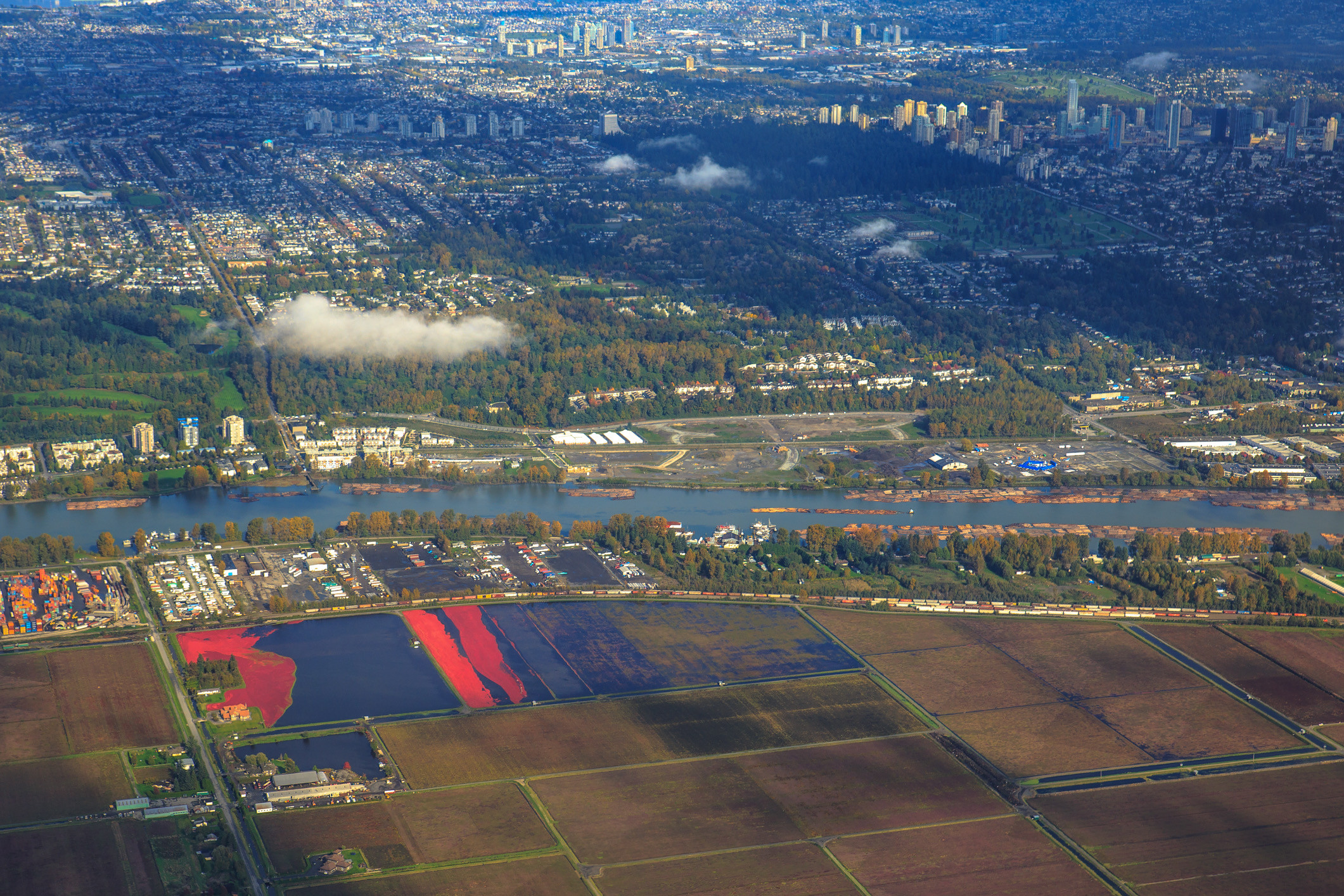
Photo: cranberry bogs and farmland beside the Fraser River in Richmond, B.C. Murray Foubister via Wikimedia Commons, CC BY-SA 2.0.