Greater Vancouver Submarket
Abbotsford.
Airport-adjacent industrial space in Abbotsford and the Fraser Valley.
Overview
Abbotsford industrial market overview
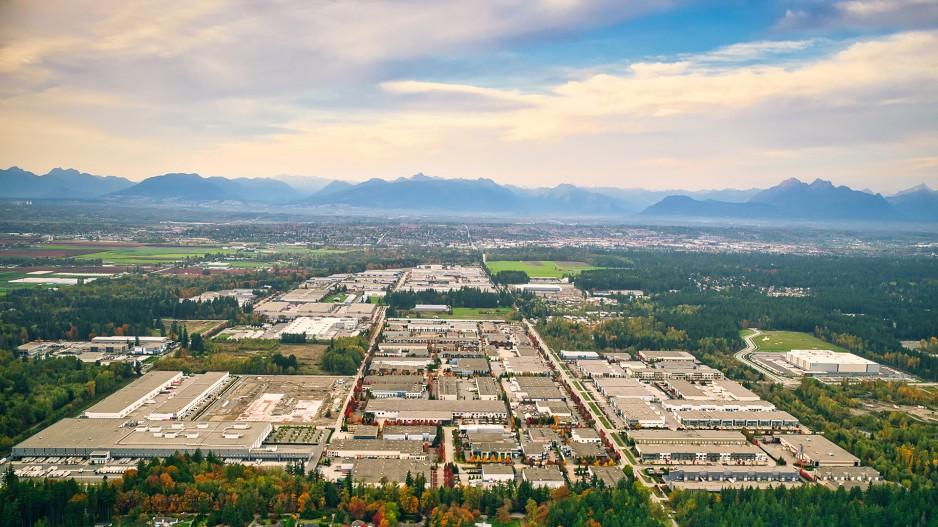
Abbotsford anchors the eastern Fraser Valley industrial market, combining airport-adjacent industrial (Abbotsford International Airport), Highway 1 corridor access, and a mix of agricultural-industrial and traditional manufacturing inventory. The submarket carries lower lease rates than the western markets, larger contiguous land availability, and a workforce shaped by the Fraser Valley's residential growth. Tenants here include regional distributors, manufacturing, food processing, and aviation-adjacent operations.
Market Snapshot
Key metrics for Abbotsford.
- Lease Range
- $17.09 PSF net average asking (Q2 2026); $16.48 – $17.60 across reports
- Vacancy
- 4.6% average (Q2 2026); 6.3% availability; varies by building class
- Clear Heights
- 28 – 36 ft in modern product; 22 – 28 ft in legacy
- Asset Mix
- Manufacturing, regional distribution, agricultural-industrial, flex
- Land Availability
- More available than western markets; ALR constrains
Defining Characteristics
What makes Abbotsford distinct.
- Abbotsford International Airport (YXX) adjacency
- Highway 1 corridor access
- Lowest occupancy cost in active Metro Vancouver industrial
- Agricultural-industrial heritage and food processing cluster
- Aviation-adjacent industrial and MRO services
- Strong manufacturing tenant base
Typical Tenant Base
Who occupies space here.
- Regional manufacturing and assembly
- Food processing and agricultural-industrial
- Aviation MRO and aerospace adjacent
- Building materials and trades
- Regional distribution serving the Fraser Valley
- Owner-user manufacturing operators
Notable Industrial Areas
Where the industrial inventory clusters.
The key industrial nodes within Abbotsford, where availability, leasing activity, and tenant turnover concentrate. Click any pin for details.
Loading map…
- 01
Industrial Node
Abbotsford International Airport industrial
- 02
Industrial Node
Sumas Way industrial corridor
- 03
Industrial Node
Highway 1 industrial frontage
- 04
Industrial Node
King Road industrial
- 05
Industrial Node
Riverside Road industrial
Why I Work Abbotsford
Working in Abbotsford industrial
Abbotsford suits operators who benefit from Abbotsford International Airport adjacency, the Fraser Valley labour catchment, or the lower occupancy cost. It is not the right answer for every business, and I will say so when it is not. I focus exclusively on industrial sales and leasing and follow the manufacturing, food processing, and aviation-adjacent tenant activity along the Highway 1 corridor in Abbotsford and the eastern Fraser Valley. I track availability and recent comparables here and help clients weigh Abbotsford against Langley and Surrey on cost and labour.
Tenants must model the commute and freight flow honestly. Abbotsford is 1.5 to 2 hours from the Vancouver core in typical traffic, which limits its viability for last-mile or time-sensitive western distribution. For aviation-adjacent, food processing, regional manufacturing, or US border-adjacent operations, the location works well. Owner-users have strong long-term opportunities, particularly in airport-adjacent industrial.
Frequently Asked Questions
Abbotsford industrial, answered.
Why would I choose Abbotsford over Langley for industrial?
Abbotsford offers meaningfully lower occupancy cost than Langley, airport adjacency for aviation or air-freight-related operations, and a stronger food processing cluster. The trade-off is additional commute distance to western Metro Vancouver. For operators whose business doesn't depend on western proximity, Abbotsford typically delivers the strongest economics in the active Metro Vancouver market.
What's special about Abbotsford airport-adjacent industrial?
Abbotsford International Airport hosts a meaningful aerospace MRO cluster, aviation-related industrial, and air-freight-adjacent operations. Tenants benefit from the airport's growing freight capacity, the established aviation supply chain, and direct airside or near-airside access for compatible uses. The airport-adjacent industrial market trades distinctly from general Abbotsford industrial.
Is Abbotsford a viable submarket for last-mile distribution?
Generally no, for Vancouver-core last-mile. Abbotsford is too far from western markets for time-sensitive last-mile flows. For regional last-mile serving the Fraser Valley, the eastern Lower Mainland, and US border markets, Abbotsford can work well. The use case matters enormously in this decision.
How does food processing concentrate in Abbotsford?
Abbotsford has a long-standing agricultural and food processing economy, supported by the Fraser Valley agricultural production hinterland. The submarket hosts dairy processing, frozen food, beverage production, and specialty food manufacturing. The cluster provides operational benefits - supplier relationships, skilled labour, established food-safety compliance ecosystem.
Related Submarkets