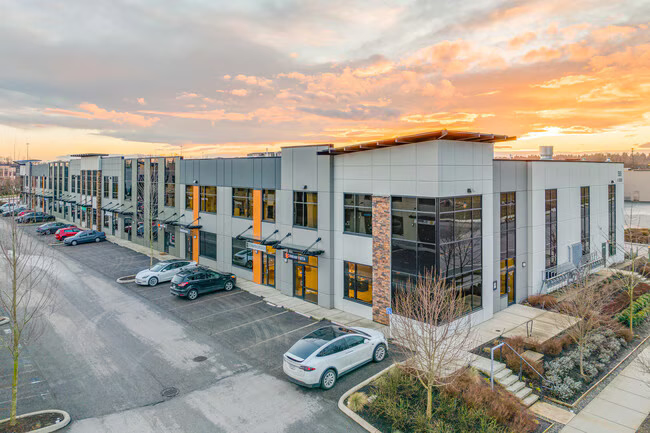
Port Coquitlam occupies a distinct position in Metro Vancouver's industrial landscape. Situated at the northeastern edge of the region's core industrial belt, the city offers a combination of highway access, functional building stock, and proximity to population centres that appeals to a range of users. The Mary Hill corridor, running along the Lougheed Highway and the parallel rail lines, forms the backbone of this submarket.
For companies priced out of Vancouver, Burnaby, or Richmond, and for investors seeking yield in a market segment with structural supply constraints, Port Coquitlam merits serious consideration. This guide examines what makes the submarket work, who it serves, and how its fundamentals compare to the broader region.
Submarket Geography and Access
The Mary Hill corridor forms the primary industrial zone in Port Coquitlam. Industrial parcels cluster along the corridor's main transportation routes. The rail infrastructure is a defining feature.
Road access is straightforward. The Lougheed Highway connects west to Burnaby and Vancouver. This positions the submarket within a reasonable drive of both Vancouver's urban core and the Fraser Valley's distribution nodes. For operators serving customers across the Lower Mainland, the central-eastern location reduces average delivery distances compared to facilities in Delta or Langley.
The corridor's geography limits lateral expansion, which shapes both the supply outlook and the competitive dynamics for existing space.
Current Market Conditions
Port Coquitlam's industrial market is among the tighter submarkets in Metro Vancouver. According to the consensus report summarizing Q2 2026 brokerage data, Port Coquitlam recorded a vacancy rate of 2.2% and an availability rate of 3.4%. These figures sit well below the Metro Vancouver averages of 4.3% vacancy and 5.8% availability.
Net asking rents in Port Coquitlam averaged $20.17 PSF, slightly above the regional average of $19.10 PSF. When combined with additional rent (operating costs and property taxes), occupiers should expect gross occupancy costs above net rent for typical space. For a practical breakdown of how net and additional rent work together, see our net lease vs gross lease guide.
The submarket's rent levels reflect both its access advantages and its supply constraints. Port Coquitlam competes directly with neighbouring Coquitlam, which posted a vacancy rate of 5.4% and net asking rents of $19.60 PSF in the same period. The rent premium in Port Coquitlam, while modest, signals that tenants are willing to pay for the tighter market and the corridor's logistics profile.
Building Stock and User Profile
The Mary Hill corridor's building inventory reflects its development history. Newer infill developments have delivered buildings with increased clear heights, but these remain a minority of available space. For users requiring modern high-cube warehousing, options in Port Coquitlam are limited, and competition for those units is intense.
The corridor serves a diverse tenant base. Distribution and logistics operators value the highway access and the ability to serve both urban and suburban customers from a single location. Light manufacturing, wholesale trade, and building supply companies occupy a significant share of the inventory. The presence of rail infrastructure attracts users with intermodal requirements, though direct rail-served buildings are rare and command a premium when available.
Unit sizes in the corridor span a wide range, appealing to owner-users, service businesses, regional distributors, and manufacturers.
Supply Constraints and Development Outlook
New industrial development in Port Coquitlam faces structural limitations. The city's industrial land base is largely built out. Infill redevelopment is possible, but it typically involves replacing older, lower-density buildings with multi-tenant strata projects or updated single-user facilities. These projects add modest increments to supply rather than transforming the market.
Across Metro Vancouver, construction activity has slowed sharply from the 2023 peak. The region has approximately 3.0 million SF under construction, down from about 11.4 million SF at the cycle's high point. For occupiers, this means that supply relief is unlikely to arrive in the near term. For owners and investors, the lack of new competition supports asset values and rent stability.
The contrast with faster-growing submarkets is instructive. Port Coquitlam's land constraints mean it cannot participate in large-scale expansion, which positions it as a stable, supply-limited submarket rather than a growth corridor.
Considerations for Occupiers
Companies evaluating the Mary Hill corridor should plan for a competitive leasing process. With vacancy at 2.2%, well-located space in functional buildings attracts multiple inquiries. Tenants benefit from preparing their requirements documentation in advance, including clear specifications for size, clear height, power, loading, and yard requirements. For guidance on structuring a search, see our how to lease industrial space guide.
Renewal tenants should expect landlords to seek rent increases at lease expiry. The submarket's fundamentals favour landlords in negotiations, though the broader regional trend of rents softening from their 2023 peak provides some context for discussions. Early engagement with landlords, typically 12 to 18 months before lease expiry, allows tenants to assess their options and negotiate from a position of information rather than urgency.
Owner-users considering a purchase in Port Coquitlam face a different calculation. Strata industrial product in the corridor offers an alternative to leasing, particularly for businesses with stable, long-term space needs. The lease-versus-buy decision depends on capital availability, financing terms, and the company's operational outlook. Our lease vs buy guide addresses the framework for that analysis.
Considerations for Owners and Investors
Port Coquitlam's supply constraints and steady demand create a favourable environment for asset owners. Buildings with functional layouts, adequate loading, and reasonable clear heights should maintain occupancy and support rent growth over time. Deferred maintenance and outdated mechanical systems represent risks, as tenants increasingly prioritize efficient, well-maintained facilities.
Investors evaluating acquisitions in the corridor should focus on tenant quality, lease term, and the physical condition of the asset. The average sale price across Metro Vancouver stands at $487 PSF, roughly a third below the 2022 peak. Port Coquitlam assets may trade above or below that figure depending on building age, configuration, and tenancy. For owners considering a disposition, our how to sell an industrial property guide outlines the process.
The corridor's proximity to residential areas introduces some considerations around intensification and land use. Municipal policies across Metro Vancouver are evolving, and owners should monitor any changes to permitted uses or density allowances that could affect redevelopment potential or operating conditions.
Key Takeaways
Port Coquitlam's Mary Hill corridor stands out as a tight, supply-constrained submarket with above-average rents and limited new construction. Its central-eastern location, highway access, and rail adjacency appeal to a range of distribution, manufacturing, and service users. For occupiers, the market requires preparation and flexibility. For owners and investors, the structural supply limitations support long-term asset performance.
NAI Commercial Vancouver tracks the Port Coquitlam market as part of our coverage across Metro Vancouver's industrial submarkets. For more detail on current conditions, visit our submarket pages or contact our team to discuss a specific requirement.
Sources
- CBRE: Vancouver Industrial Figures, Q2 2026
- Colliers: Vancouver Industrial Market Report, Q2 2026
- Cushman & Wakefield: Vancouver Industrial MarketBeat, Q2 2026
- Avison Young: Metro Vancouver Industrial Market Report, Q2 2026
- JLL: Greater Vancouver Area Industrial Market Dynamics, Q2 2026
- Lee & Associates: Vancouver, BC Industrial Market Overview, Q2 2026