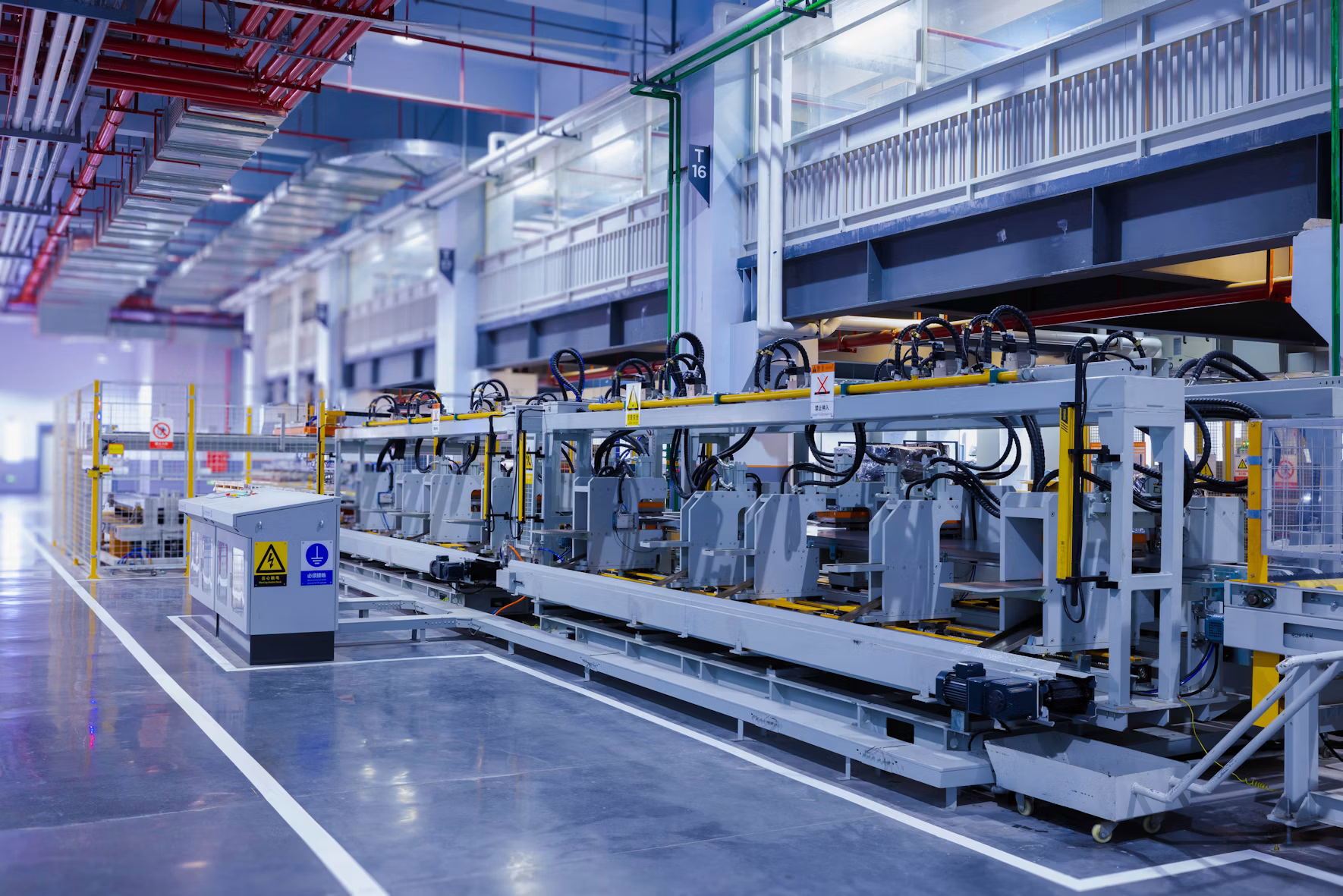
When manufacturing operators evaluate potential facilities in Metro Vancouver, square footage, ceiling height, and lease economics typically dominate initial discussions. Power capacity often receives less attention during early site tours, until it emerges as a deal-breaker late in the process. For operations requiring substantial electrical loads, understanding the region's power infrastructure landscape before committing to a site can save months of delays and hundreds of thousands of dollars in upgrade costs.
Why Power Capacity Deserves Early Due Diligence
Manufacturing operations vary dramatically in their electrical requirements. A light assembly operation might function adequately with standard 200-amp, 600-volt three-phase service. A food processing facility with refrigeration, a plastics extruder, or a metal fabrication shop with CNC equipment and welding stations may require 800 amps, 1,600 amps, or significantly more. Data-intensive manufacturing and testing facilities, increasingly common as the region attracts advanced manufacturing, can demand power densities that exceed what most older industrial buildings were designed to accommodate.
The challenge in Metro Vancouver is that much of the existing industrial inventory was constructed between the 1970s and early 2000s for warehousing and distribution uses. These buildings often have electrical systems sized for lighting, dock equipment, and modest office loads, not continuous industrial processes. A building that appears ideal based on location, size, and asking rate may require a complete electrical service upgrade before a manufacturer can operate.
Understanding BC Hydro Service Classifications
BC Hydro categorizes industrial electrical service into several tiers that directly affect both timeline and cost for manufacturers:
- Secondary service (under 35 kV) covers most small to mid-sized manufacturing operations. Buildings with existing secondary service at adequate amperage can often accommodate new tenants with minimal electrical work beyond internal distribution upgrades.
- Primary service (35 kV) becomes necessary for facilities with loads exceeding approximately 1,500 kVA. This requires the customer to own and maintain transformer equipment, adding capital cost and ongoing maintenance obligations.
- Transmission service (69 kV and above) applies to the largest industrial consumers. Few manufacturing operations in Metro Vancouver require this level, but heavy industrial users in certain Delta and Surrey locations may encounter transmission-level infrastructure.
The critical factor for site selection is the service level available to a building and also the capacity available on the local distribution system. A building may have 400-amp service today, but if the local substation and feeder lines are already near capacity, upgrading that building to 1,600 amps could require BC Hydro to extend new infrastructure, a process that can take 18 to 36 months and cost the customer for system extensions beyond standard allowances.
Submarket Variations in Power Infrastructure
Power availability varies meaningfully across Metro Vancouver's industrial submarkets, reflecting both the age of development and the historical tenant mix:
Vancouver proper presents mixed conditions. Older industrial areas around Clark Drive and the Flats contain buildings with limited electrical capacity, though proximity to established grid infrastructure can sometimes facilitate upgrades. Net asking rents averaged about $20.10 per square foot in Q2 2026, and landlords may resist capital-intensive tenant improvements unless lease terms justify the investment.
Burnaby offers some advantages for manufacturers. The Big Bend area and Marine Way corridor include buildings constructed for industrial users, with many featuring 600-amp to 1,600-amp service. However, demand from film production and advanced manufacturing has tightened availability of power-ready space.
Richmond benefits from relatively modern grid infrastructure, particularly in areas developed since the 1990s. Cold storage and food processing clusters have driven investment in robust electrical systems. Manufacturers seeking 800-amp or higher service often find more options here than in older submarkets, though competition from logistics users keeps vacancy tight.
Surrey and Langley present the broadest range of conditions. Campbell Heights and newer Langley developments offer buildings designed with contemporary electrical standards, often 400-amp to 800-amp service with capacity for upgrades. Older Port Kells and Newton industrial areas vary significantly building to building. Grid capacity in expanding areas like Aldergrove requires verification, as development has occasionally outpaced infrastructure investment.
Delta and the Tilbury area include properties with heavy industrial heritage. Some facilities near Annacis Island and the river industrial zones retain substantial electrical infrastructure from previous manufacturing or processing uses, potentially reducing upgrade requirements for new occupants.
Quantifying Upgrade Costs and Timelines
Manufacturers should budget realistically for electrical infrastructure scenarios:
- Internal distribution upgrades within an adequately served building (new panels, wiring, and connections for equipment) typically range from $50,000 to $200,000 depending on complexity.
- Service upgrades requiring BC Hydro involvement but using existing transformer and feeder capacity may cost $100,000 to $400,000 and require 6 to 12 months.
- System extensions requiring new transformer installations or feeder construction can exceed $500,000 and extend timelines to 24 months or longer. BC Hydro provides cost estimates through its connection process, but final engineering can reveal additional requirements.
Landlords and tenants must negotiate responsibility for these costs. With Metro Vancouver industrial vacancy averaging 4.3% across the Q2 2026 brokerage reports, landlords have more reason than they did in 2022 to contribute to upgrades, but few will fund speculative electrical work. Most heavy-power improvements occur as tenant-funded improvements, sometimes amortized into lease rates over extended terms.
Practical Steps for Power-Conscious Site Selection
Manufacturers can protect their timelines and budgets by incorporating power due diligence early in the site selection process:
- Define electrical requirements precisely before touring properties. Work with equipment suppliers and electrical engineers to document connected load, demand load, voltage requirements, and any specialized needs such as redundancy or power quality standards.
- Request electrical documentation for any property under serious consideration. Single-line diagrams, transformer specifications, and recent BC Hydro bills can reveal actual available capacity.
- Engage BC Hydro early for facilities requiring service changes. The utility offers preliminary assessments that identify potential capacity constraints before a tenant commits to a lease.
- Evaluate total occupancy cost including electrical upgrades, not only base rent. A building at $18 per square foot requiring $400,000 in electrical work may cost more over a seven-year term than a $22 per square foot building with adequate existing service.
- Negotiate improvement allowances and timelines explicitly in lease documents. Electrical upgrade delays can cascade into missed production schedules and contractual penalties with customers.
Working With Knowledgeable Advisors
Brokers with manufacturing client experience understand that power capacity shapes site viability as directly as zoning or access. At NAI Commercial Vancouver, we routinely coordinate with electrical consultants and BC Hydro representatives during the site selection process for manufacturing clients, ensuring that promising buildings receive technical vetting before lease negotiations advance. The NAI Global network also provides access to manufacturing facility expertise in other markets, useful for operators expanding into Metro Vancouver from other jurisdictions.
Power capacity is not a detail to resolve after signing a lease. It is a threshold criterion that belongs in initial screening. Manufacturers who integrate electrical infrastructure analysis into their site selection framework avoid costly surprises and position themselves to begin operations on schedule. In a region where power-ready industrial space remains scarce even as overall vacancy has loosened, and construction timelines extend well beyond historical norms, that discipline provides meaningful competitive advantage.