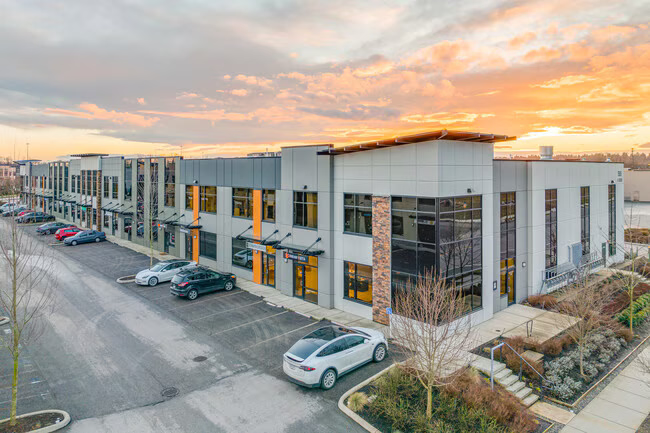
Last-mile logistics, the final leg of delivery from distribution hub to end customer, has reshaped how occupiers evaluate industrial real estate in Metro Vancouver. The rise of same-day and next-day delivery expectations, combined with the region's geographic constraints, has intensified competition for strategically located facilities. For owners, occupiers, and investors, understanding the nuanced trade-offs in last-mile site selection is essential to making sound real estate decisions.
Why Last-Mile Site Selection Differs from Traditional Distribution
Traditional distribution centre site selection prioritizes access to major highway corridors and port infrastructure, with secondary consideration for labour availability and building specifications. Last-mile logistics introduces a fundamentally different calculus: proximity to population density becomes the primary driver.
In Metro Vancouver, this shift has meaningful implications. A 100,000-square-foot regional distribution centre in Campbell Heights may offer efficient access to the U.S. border and competitive lease rates, but it fails the last-mile test for serving Vancouver's urban core. Conversely, a 25,000-square-foot facility in East Vancouver commands premium rents but enables delivery economics that justify the cost differential.
The key metrics for last-mile site selection include:
- Delivery radius coverage: The percentage of target customers reachable within a defined time window (typically 2-4 hours)
- Population density per kilometre: Higher density improves delivery route efficiency
- Traffic pattern analysis: Peak congestion periods and alternative routing options
- Return logistics accessibility: Increasingly important as e-commerce return rates climb
Submarket Analysis for Last-Mile Operations
Metro Vancouver's industrial submarkets present distinct profiles for last-mile operators. Understanding these differences allows occupiers to align real estate decisions with operational requirements.
Vancouver and Burnaby: These urban submarkets offer the tightest proximity to Metro Vancouver's population centre but have few sites with the yard depth last-mile operators need. Vacancy averaged about 5.4% in Vancouver and 4.9% in Burnaby across the Q2 2026 brokerage reports, with net asking rents averaging about $20.10 and $19.67 per square foot respectively, and quality distribution space pricing above those averages. Facilities here typically serve hyper-local delivery models or function as cross-dock operations feeding smaller urban delivery vehicles. Building inventory skews older, with clear heights often limited to 22-26 feet.
Richmond: Richmond provides a middle-ground option on geography, though at about 3.4% vacancy in Q2 2026 it is actually tighter than Vancouver or Burnaby. The submarket benefits from Sea Island access and proximity to Vancouver International Airport, making it attractive for time-sensitive logistics. Net asking rents averaged about $20.26 per square foot in Q2 2026, with variation by building quality and location within the submarket. The Bridgeport area and areas near the Knight Street corridor see particular demand from last-mile operators.
Surrey and Delta: These submarkets have emerged as the primary location for larger last-mile facilities serving the broader region. Annacis Island and Tilbury offer established industrial infrastructure, with Delta net asking rents averaging about $17.91 per square foot in Q2 2026. Port Kells and the emerging Campbell Heights business park provide newer construction with modern specifications (clear heights of 32 feet or greater, ESFR sprinkler systems, and ample trailer parking), with Surrey averaging about $18.66 per square foot and premium product above that.
Langley and Abbotsford: The eastern submarkets serve operators willing to accept longer travel times to urban centres in exchange for larger floor plates and, in Abbotsford, lower occupancy costs. Net asking rents averaged about $19.20 per square foot in Langley and $17.09 in Abbotsford in Q2 2026. These locations work for last-mile operations targeting Fraser Valley communities or as secondary distribution points feeding smaller urban facilities.
Building Specifications for Last-Mile Efficiency
Last-mile operations impose specific building requirements that differ from traditional warehousing. Site selection must account for these operational realities:
Dock configuration: High-velocity last-mile operations require dock door ratios significantly above traditional warehousing, often one door per 5,000-7,000 square feet versus the conventional one per 10,000 square feet. Cross-dock configurations with doors on opposing walls enable flow-through operations essential for same-day distribution.
Yard depth and circulation: Delivery van staging, trailer parking, and employee parking compete for limited yard space. Minimum yard depths of 120 feet are typically required, with 130-150 feet preferred for high-volume operations. In land-constrained submarkets like Vancouver and Burnaby, this requirement alone eliminates many available options.
Clear height considerations: While traditional distribution benefits from 36-foot-plus clear heights, many last-mile operations can function effectively in 24-28-foot buildings. This expands the available inventory in urban submarkets where older building stock predominates.
Power and charging infrastructure: The transition to electric delivery vehicles is accelerating fleet electrification requirements. Forward-thinking occupiers are evaluating electrical capacity and the feasibility of charging infrastructure installation as part of site selection criteria.
Lease Structure Considerations
Last-mile facility leases present negotiation points distinct from traditional industrial transactions. Occupiers should consider:
Term length flexibility: The rapid evolution of delivery networks means operational requirements may shift within a standard 5-7 year lease term. Shorter initial terms with renewal options, or early termination rights tied to specific performance thresholds, provide valuable flexibility.
Operating hour provisions: Twenty-four-hour operations are standard for many last-mile facilities. Lease terms should explicitly permit extended operating hours and address any landlord or municipal restrictions that could constrain operations.
Improvement allowances: Dock door additions, electrical upgrades, and yard improvements often require capital investment. Negotiating tenant improvement allowances or landlord work letters that address these requirements can significantly impact effective occupancy costs.
Exclusivity provisions: In multi-tenant properties, occupiers may seek restrictions preventing landlords from leasing adjacent space to direct competitors, protecting delivery route density advantages.
The Network Approach to Site Selection
Sophisticated last-mile operators increasingly view site selection through a network lens rather than evaluating individual locations in isolation. This approach recognizes that a combination of facilities (perhaps a larger facility in Surrey feeding smaller urban cross-docks in Vancouver and Burnaby) may outperform any single location.
NAI Commercial Vancouver works with occupiers to model these network configurations, drawing on transaction data across Metro Vancouver submarkets. The NAI Global network provides additional perspective for operators expanding into or from other markets, enabling comparison of Metro Vancouver's last-mile real estate dynamics with other major Canadian and North American distribution hubs.
Network modelling typically evaluates total occupancy cost against delivery performance metrics, identifying the configuration that optimizes both. For many operators, this analysis reveals that paying premium rents for a small urban facility generates positive returns through reduced delivery costs and improved service levels.
Practical Takeaways for Site Selection
Effective last-mile site selection in Metro Vancouver requires balancing competing priorities within a constrained market. Occupiers benefit from defining delivery performance requirements before beginning the site search: understanding the customer geography to be served, required delivery windows, and acceptable travel times from facility to customer. This framework enables objective evaluation of submarkets and specific properties against operational needs rather than defaulting to lowest-cost options that may underperform.
For owners and investors, recognizing the premium that last-mile operators place on specific location and building attributes informs both acquisition targeting and capital improvement decisions. Properties that may appear functionally obsolete for traditional warehousing can command strong rents when configured for high-velocity distribution operations.
The continued growth of e-commerce delivery expectations suggests that well-located last-mile facilities will remain among Metro Vancouver's most sought-after industrial assets. Thoughtful site selection today positions occupiers and investors to benefit from that sustained demand.