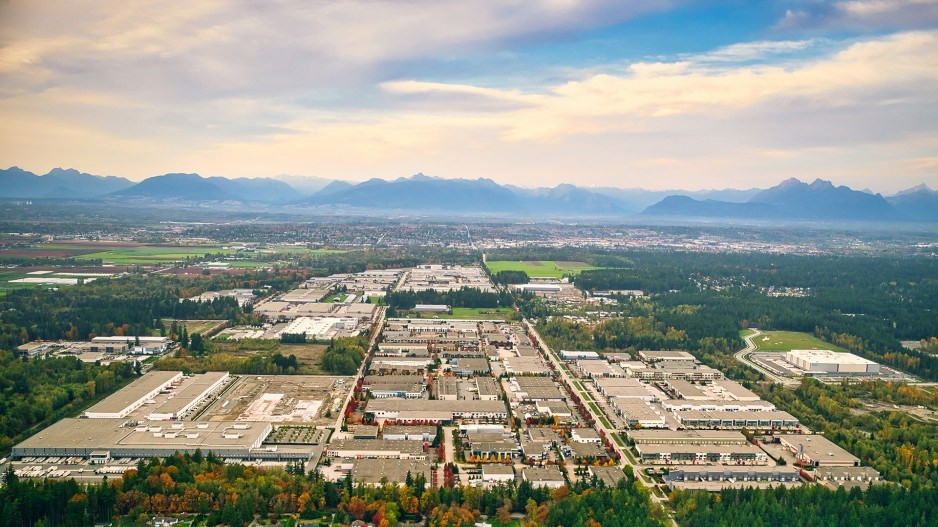
Metro Vancouver's industrial land scarcity is not a market cycle phenomenon. It is a permanent structural condition shaped by geography, agricultural protection, urban encroachment, and regulatory boundaries that will not shift in any meaningful timeframe. For owners, occupiers, and investors in the region's industrial real estate market, understanding why supply cannot catch up to demand is essential to making informed decisions about leasing, acquisition, and long-term positioning.
The Geography That Defines the Constraint
Metro Vancouver sits in a narrow corridor between the Coast Mountains to the north and the United States border to the south. The Fraser River bisects the region, and significant portions of the valley floor lie within the Agricultural Land Reserve. Of the region's approximately 2,880 square kilometres of total land area, only a fraction is zoned or zonable for industrial use.
Current estimates place the total industrial land inventory across Metro Vancouver at approximately 10,500 hectares. Of that, less than 400 hectares remain vacant and available for development as of mid-2026. That figure has declined steadily over the past decade, and the trajectory shows no sign of reversal.
Unlike industrial markets in Calgary, the Greater Toronto Area, or the American Pacific Northwest, Metro Vancouver cannot expand outward. Seattle-Tacoma's industrial inventory benefits from developable land extending south toward Tacoma and east into the Kent Valley. Metro Vancouver has no equivalent expansion zone. The ALR, which protects approximately 4,700 hectares within the region, removes most of the Fraser Valley's flat, serviceable land from industrial consideration.
Absorption Against a Fixed Base
Between 2015 and 2025, Metro Vancouver absorbed approximately 2.2 million square feet of industrial space annually on average. New supply deliveries over that period were inconsistent, with several years falling well below absorption levels. The result has been a steady compression of vacancy rates, which dropped below 1 percent in 2022 and remained at or below 1.5 percent through 2025.
As of Q3 2026, regional vacancy sits at approximately 1.8 percent—a slight increase from the historic lows of 2022 and 2023, but still well below the equilibrium range of 4 to 5 percent that would indicate a balanced market. The modest uptick reflects a combination of sublease availability from tenants adjusting post-pandemic space requirements and a handful of speculative projects reaching completion in Surrey and Langley.
The critical point is this: even if vacancy rises modestly in the near term, the underlying land constraint ensures that any demand recovery will quickly re-tighten the market. There is no land bank waiting to absorb a development surge.
Where the Remaining Land Sits
The remaining developable industrial land in Metro Vancouver is concentrated in three primary areas: Campbell Heights in South Surrey, Langley's industrial zones east of 200th Street, and portions of Delta near the Tilbury industrial corridor. Each of these areas faces limitations.
Campbell Heights has been Metro Vancouver's primary release valve for large-format industrial development over the past decade. However, the City of Surrey has signalled that the business park is approaching buildout. The 32 Avenue widening project, currently underway, will improve access and unlock final phases of development, but the net addition of land is measured in hundreds of acres, not thousands.
Langley and Aldergrove offer the region's most significant remaining inventory of developable industrial land, but much of it requires infrastructure investment—particularly road access, water, and sewer servicing—that extends development timelines. Parcels that are fully serviced and entitled command premium pricing and typically trade to end-users or developers with specific build-to-suit requirements.
Delta's Tilbury corridor benefits from proximity to the Fraser Surrey Docks and planned LNG infrastructure, but the area's industrial land supply is finite. Several major logistics and energy-related users have absorbed significant acreage over the past five years, leaving limited availability for new entrants.
The Economics of Scarcity
Land scarcity in Metro Vancouver has produced pricing dynamics that distinguish the region from nearly every other Canadian industrial market. Industrial land values in core submarkets—Vancouver proper, Burnaby, and Richmond—now exceed $3.5 million per acre in many cases, with select sites trading above $4 million per acre. Even in the region's eastern submarkets, where land was historically more affordable, pricing has climbed to the $1.5 million to $2.2 million per acre range for serviced, entitled parcels.
These land costs flow directly into lease rates. Asking rents for modern Class A industrial space in Metro Vancouver now range from $22 to $28 per square foot net in most submarkets, with Vancouver proper and Burnaby commanding $26 to $32 per square foot for well-located product. These figures represent a near-doubling from the $12 to $15 per square foot range that prevailed a decade ago.
For occupiers, this means lease economics require careful attention to escalation structures, term length, and renewal options. Locking in favourable terms on a seven- to ten-year lease in a supply-constrained market can represent significant value protection. For owners and investors, the scarcity premium supports asset values but also limits acquisition opportunities—particularly for stabilized, income-producing properties that rarely trade.
Intensification as a Partial Response
Municipal governments across Metro Vancouver have increasingly turned to industrial intensification policies as a response to land scarcity. Burnaby's Big Bend area, Richmond's industrial zones, and Vancouver's False Creek Flats all permit or encourage multi-storey industrial development, higher site coverage, and reduced parking ratios in certain circumstances.
Intensification has merit. A two- or three-storey industrial building on a constrained site can deliver floor area that would otherwise require greenfield development. However, intensification is not a substitute for land supply. Multi-storey industrial construction costs significantly more per square foot than single-storey development, and not all uses—particularly heavy manufacturing, cold storage, and logistics operations requiring grade-level loading—can function in stacked formats.
The result is that intensification addresses a portion of demand, primarily from light industrial, flex, and small-bay users, while doing little to accommodate the large-format distribution and manufacturing facilities that drive much of the region's absorption.
What This Means for Market Participants
For tenants, Metro Vancouver's land scarcity requires proactive planning. Lease renewals should begin 18 to 24 months in advance of expiry. Occupiers with expansion requirements need to assess relocation options early, recognizing that suitable alternatives may not exist in their preferred submarket. Build-to-suit arrangements, while complex, may represent the only path to securing purpose-built space in some size ranges.
For owners, the scarcity dynamic supports long-term asset values but also creates pressure to maximize site utilization. Properties with excess land coverage, underutilized yards, or aging improvements may benefit from redevelopment analysis to capture higher and better use potential.
For investors, Metro Vancouver's industrial market offers yield compression relative to other Canadian markets, but that compression reflects genuine supply constraints rather than speculative pricing. Underwriting should account for the permanence of land scarcity when evaluating hold periods, exit assumptions, and rent growth projections.
At NAI Commercial Vancouver, our advisory work with owners, occupiers, and investors consistently returns to the land constraint as the defining feature of this market. Understanding that constraint—and planning around it—is the foundation of sound industrial real estate strategy in Metro Vancouver.