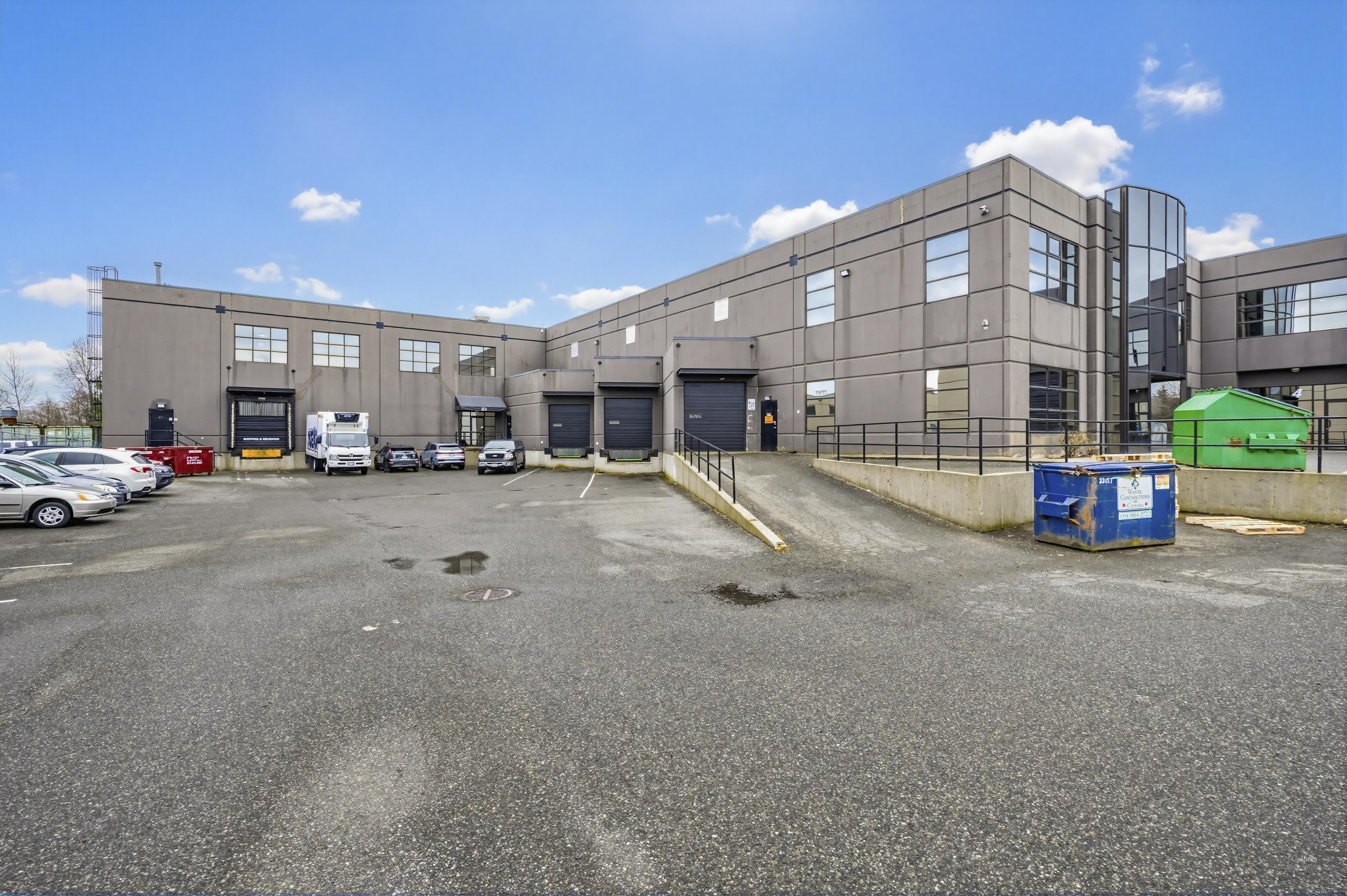
Abbotsford sits at the eastern edge of Metro Vancouver's industrial footprint, where the Fraser Valley's agricultural heritage intersects with modern logistics and light manufacturing. For owners, occupiers, and investors evaluating opportunities beyond the region's core submarkets, Abbotsford presents a distinct value proposition shaped by two defining characteristics: direct adjacency to Abbotsford International Airport and a concentration of agricultural and food processing operations that is unmatched elsewhere in the region.
Market Position Within Metro Vancouver
Abbotsford's industrial market trades at a discount to the regional average while maintaining fundamentals that compare favourably to other peripheral submarkets. According to the consensus report, Abbotsford recorded a vacancy rate of 4.6% and an availability rate of 6.3% as of mid-2026. Average net asking rents sit at approximately $17.09 PSF, with additional rent typically running $6 to $7 PSF on top. This positions Abbotsford roughly $2.00 PSF below the Metro Vancouver average net asking rent of $19.10 PSF.
The rent differential reflects geography more than quality. Abbotsford is approximately 70 kilometres from the Port of Vancouver and the core distribution nodes in Burnaby and Richmond. For occupiers whose operations do not require daily port access or proximity to Vancouver's population density, the savings compound meaningfully over a lease term. Suppose a 30,000 SF requirement at $17.09 PSF net versus $19.10 PSF net: the annual difference exceeds $60,000 before considering additional rent, which tends to be comparable across submarkets.
The Airport Advantage
Abbotsford International Airport offers an alternative to Vancouver International Airport for industrial users requiring air cargo access. While Vancouver International Airport handles the bulk of air freight, its location on Sea Island creates constraints around land availability and operating hours that do not apply in Abbotsford.
Industrial users requiring air cargo access, whether for time-sensitive parts, perishable goods, or high-value components, find Abbotsford's airport adjacency operationally practical. The industrial areas surrounding the airport offer direct truck access without the congestion that characterizes routes to YVR. For aerospace maintenance, repair, and overhaul operations, Abbotsford provides runway access combined with industrial zoning that permits the heavy uses these tenants require.
The airport's freight capacity also supports businesses that ship to markets outside the Lower Mainland. Agricultural exporters, in particular, benefit from the ability to move product by air without routing through Vancouver's more congested infrastructure.
Agricultural-Industrial Clustering
Abbotsford's agricultural roots create a demand profile that differs from the logistics-dominated submarkets closer to the port. The surrounding Fraser Valley is one of British Columbia's most productive agricultural regions, and Abbotsford has historically served as the processing and distribution hub for that production.
Food and beverage industrial users, from cold storage operators to primary processors, concentrate here for several practical reasons. First, proximity to source: operations that receive raw agricultural inputs benefit from shorter truck routes and reduced spoilage risk. Second, zoning: Abbotsford's industrial zones accommodate the heavier utility loads, wastewater requirements, and odour profiles that food processing generates, uses that face greater scrutiny in municipalities closer to residential density. Third, workforce: the region's agricultural economy supports a labour pool familiar with food handling, production schedules, and the seasonal rhythms that characterize these operations.
For occupiers in food and beverage manufacturing or cold chain logistics, Abbotsford offers a rare combination: industrial land that accommodates their operational requirements, a supplier network within trucking distance, and rents that allow capital to be allocated toward equipment and facility improvements rather than lease obligations.
Land Constraints and the ALR
Like much of Metro Vancouver, Abbotsford's industrial supply is constrained by the Agricultural Land Reserve. The ALR surrounds the city's developed industrial areas, limiting outward expansion and creating scarcity dynamics similar to those in more central submarkets. Unlike Langley or Surrey, however, Abbotsford has not experienced the same intensity of speculative development over the past cycle.
This creates both challenges and opportunities. For tenants seeking large-bay space exceeding 100,000 SF, options are limited. The regional market has only about 17 blocks of large-bay space available across all submarkets, and Abbotsford's share is modest. Occupiers with substantial footprint requirements will need to consider build-to-suit arrangements or look at multiple smaller facilities.
For smaller users, the market is more accommodating. Metro Vancouver has more than 10 million square feet of small-bay space under 40,000 SF available, and Abbotsford contributes to that inventory. Users in the 5,000 to 25,000 SF range will find reasonable selection, particularly for facilities suited to light manufacturing, distribution, and agricultural processing.
Investors evaluating Abbotsford should note that ALR constraints function as a supply ceiling. The same limitations that frustrate occupiers seeking expansion protect existing owners from oversupply. With under construction inventory across Metro Vancouver at approximately 3.0 million SF, down sharply from the 2023 peak of about 11.4 million SF, new competitive supply is not arriving quickly.
Operational Considerations for Occupiers
Abbotsford's distance from Vancouver creates trade-offs that occupiers must evaluate against their distribution patterns. Last-mile delivery operations serving Vancouver's urban core will find the distance impractical. Regional distribution serving the Fraser Valley, the Interior, or cross-border markets into Washington State may find the location advantageous.
Highway 1 provides the primary connection westward to Vancouver and eastward toward Chilliwack and beyond. Traffic patterns vary significantly by time of day, and occupiers running shift operations or early-morning deliveries can often avoid the worst congestion. Cross-border users benefit from proximity to the Sumas border crossing, which handles commercial truck traffic with less delay than the crossings closer to Vancouver.
Building specifications in Abbotsford's industrial stock vary. Older facilities may offer lower clear heights and limited dock doors, while newer construction tends toward the 28-foot to 32-foot clear heights and multiple loading positions that modern logistics require. Users should conduct thorough due diligence on building condition, electrical capacity, and yard configuration before committing to a lease or purchase. For guidance on evaluating these factors, see our guide to leasing industrial space.
Investment Characteristics
Abbotsford's industrial assets trade at metrics that reflect the submarket's peripheral position. Average sale prices across Metro Vancouver run approximately $487 PSF, roughly a third below the 2022 peak. Abbotsford properties typically trade below this regional average, though precise pricing depends on building quality, tenant profile, and lease structure.
For investors, the submarket offers a yield premium over core markets in exchange for accepting the operational realities of a more distant location. Credit quality among Abbotsford's tenant base skews toward regional operators, agricultural businesses, and owner-users rather than the national logistics firms and institutional tenants that dominate buildings closer to the port.
Owners considering a sale should understand how buyers underwrite peripheral submarkets differently than core locations. Tenant covenant, lease term, and building functionality carry greater weight when location alone does not command premium pricing. For more on the sales process, see our guide to selling industrial property.
Practical Takeaways
Abbotsford occupies a specific niche within Metro Vancouver's industrial landscape. It is not a substitute for port-proximate submarkets, nor does it compete directly with the logistics clusters in Surrey, Delta, or Richmond. Its value lies in the combination of airport adjacency, agricultural-industrial clustering, and rental rates that run meaningfully below the regional average.
For occupiers in food processing, agricultural distribution, aerospace services, or regional logistics serving the Fraser Valley and Interior markets, Abbotsford warrants serious evaluation. For investors seeking yield in a supply-constrained market, the submarket offers opportunities that reward careful underwriting and local knowledge.
NAI Commercial Vancouver tracks Abbotsford alongside the broader Metro Vancouver industrial market. For submarket-specific analysis or to discuss how Abbotsford fits within a broader site selection process, please contact our team.
Sources
- CBRE: Vancouver Industrial Figures, Q2 2026 (published 2026-07-28)
- Colliers: Vancouver Industrial Market Report, Q2 2026 (published 2026-07-10)
- Cushman & Wakefield: Vancouver Industrial MarketBeat, Q2 2026 (published 2026-07-02)
- Avison Young: Metro Vancouver Industrial Market Report, Q2 2026 (published 2026-07-15)
- JLL: Greater Vancouver Area Industrial Market Dynamics, Q2 2026 (published 2026-07-16)
- Lee & Associates: Vancouver, BC Industrial Market Overview, Q2 2026 (published 2026-07-15)