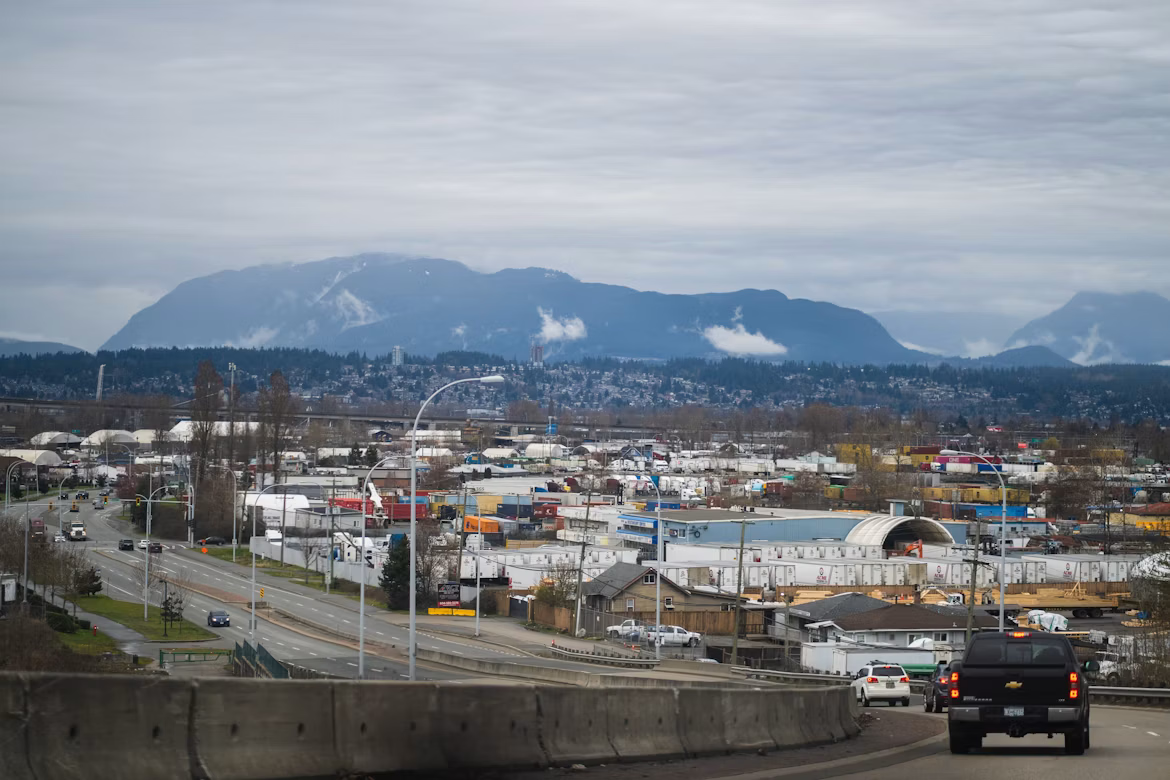
Rent escalation clauses determine how your base rent increases over a lease term. In Metro Vancouver's industrial market, where net asking rates climbed from the $12-14 PSF range in 2020 to a peak near $22 in 2023 before easing to an average of about $19.10 PSF in Q2 2026, the structure of your escalation clause can mean tens of thousands of dollars in additional occupancy costs—or savings—over a five- to ten-year term.
Yet escalation terms often receive less negotiating attention than initial rent or tenant improvement allowances. This post breaks down the three primary escalation structures used in Metro Vancouver industrial leases, explains how each performs under different economic conditions, and offers guidance on selecting the right structure for your situation.
The Three Common Escalation Structures
Metro Vancouver industrial leases typically employ one of three rent escalation mechanisms:
- Fixed Percentage Escalations: Rent increases by a predetermined percentage annually—commonly 2.5% to 4% in the current market. A lease starting at $20.00 PSF with 3% annual escalations reaches $21.85 PSF by year four.
- Consumer Price Index (CPI) Escalations: Rent adjusts annually based on changes to the British Columbia or Canada-wide CPI. These clauses typically reference Statistics Canada data with a specified measurement period.
- Hybrid or Capped CPI Escalations: Rent increases by CPI but with a floor (minimum) and ceiling (maximum). A typical structure might specify "CPI with a floor of 2% and a cap of 5%."
Each structure allocates inflation risk differently between landlord and tenant. Understanding this allocation is essential to evaluating lease proposals.
Fixed Escalations: Predictability at a Premium
Fixed percentage escalations dominate Metro Vancouver industrial leases, particularly for institutional landlords and in premium submarkets like Vancouver proper, Burnaby, and Richmond. Current market standard ranges from 3% to 3.5% annually for new leases, though some landlords in high-demand areas push for 4%.
The appeal for tenants is straightforward: complete predictability. You can model your occupancy costs for the entire lease term on day one. For businesses with tight margins or those preparing financial projections for lenders or investors, this certainty has real value.
The tradeoff is that fixed escalations typically exceed actual inflation in stable economic periods. British Columbia's CPI averaged 2.1% annually from 2015 to 2019, meaning a 3% fixed escalation would have cost tenants roughly 0.9% more per year than a pure CPI structure during that period.
However, the 2021-2023 inflationary surge—when B.C. CPI exceeded 6% in some months—demonstrated the opposite risk. Tenants locked into 3% fixed escalations during that period paid below-market increases while landlords absorbed the gap between contractual and actual inflation.
CPI Escalations: Sharing Inflation Risk
Pure CPI escalations tie rent increases directly to measured inflation. In theory, this creates a fair sharing of economic conditions—landlords maintain purchasing power parity while tenants pay increases that reflect broader cost pressures affecting their businesses.
In practice, pure CPI clauses have become less common in Metro Vancouver industrial leases since 2022. Landlords who experienced the gap between 3% contractual escalations and 6-7% actual inflation have grown wary of uncapped exposure in either direction.
When negotiating CPI clauses, pay attention to:
- Index Selection: B.C. CPI versus Canada-wide CPI can differ by 0.3-0.5% in a given year. Over a ten-year term, this compounds meaningfully.
- Measurement Period: Does the clause reference year-over-year CPI as of a specific month, or an average over several months? The latter reduces volatility but adds complexity.
- Negative CPI: Most leases specify that CPI escalations cannot result in rent decreases, even during deflationary periods. Confirm this is addressed explicitly.
CPI escalations require more administrative attention than fixed increases. Both parties must track index publications and calculate adjustments accurately—a minor operational consideration but worth noting for smaller organizations without dedicated lease administration staff.
Hybrid Structures: Bounded Flexibility
Capped CPI escalations have gained traction in Metro Vancouver since 2023, offering a middle ground that addresses both parties' concerns. A typical structure might read: "Annual rent shall increase by the greater of (a) 2% or (b) the percentage change in the British Columbia Consumer Price Index, provided that no annual increase shall exceed 5%."
This structure guarantees landlords a minimum 2% annual increase while protecting tenants from runaway inflation adjustments. The 2-5% band has become reasonably standard, though negotiated ranges vary. Some institutional landlords accept narrower bands (2.5-4%) for credit tenants or longer-term commitments.
For tenants, hybrid structures provide bounded uncertainty—you know your worst-case and best-case escalation scenarios, enabling more accurate financial planning than pure CPI while potentially outperforming fixed escalations in low-inflation environments.
The negotiation leverage for band width typically correlates with lease term, tenant credit quality, and market conditions at signing. In the current 2026 environment, with vacancy averaging 4.3% across the Q2 2026 brokerage reports and net rents down year over year, tenants have more leverage on escalation terms than they did from 2021 to 2023, particularly in small-bay space where supply is plentiful.
Submarket Variations and Market Norms
Escalation expectations vary across Metro Vancouver's industrial geography:
- Vancouver Proper and Burnaby: Institutional ownership concentration means standardized lease forms with 3-3.5% fixed escalations as the default. Deviation requires negotiating against established templates.
- Richmond: Mixed ownership profile creates more variation. Strata industrial often sees lower fixed escalations (2.5-3%) while multi-tenant properties held by REITs maintain 3%+ standards.
- Surrey and Delta: Greater lease term flexibility translates to more negotiable escalation structures. CPI and hybrid clauses appear more frequently, particularly for larger footprints in Port Kells, Campbell Heights, and the Tilbury corridor.
- Langley and Abbotsford: Private ownership predominance and emerging submarket status create the most variability. Fixed escalations range from 2.5% to 4% depending on building quality and landlord sophistication.
These patterns reflect ownership composition as much as market fundamentals. Institutional landlords operating across multiple markets typically enforce standardized escalation terms regardless of submarket, while private owners demonstrate more flexibility.
Evaluating Escalation Proposals
When comparing lease proposals with different escalation structures, model total occupancy costs across the full term under multiple inflation scenarios. A lease with lower starting rent but aggressive 4% fixed escalations may cost more over seven years than a higher initial rate with CPI-based increases—depending on actual inflation outcomes.
Consider your business's inflation exposure. If your revenue correlates with inflation (pricing power in your industry), CPI escalations create natural alignment between rent costs and revenue growth. If your pricing is constrained, fixed escalations provide cost certainty that may outweigh potential savings from CPI in low-inflation scenarios.
For tenants negotiating renewals or new leases in the current Metro Vancouver market, escalation terms warrant the same analytical attention as base rent. The difference between a 3% fixed escalation and a 2-4% capped CPI structure may appear minor in year one but compounds to meaningful variance over a standard five- to ten-year industrial lease term.
NAI Commercial Vancouver advises tenants and landlords on lease economics across Metro Vancouver's industrial submarkets. Understanding how escalation structures interact with base rent, tenant improvements, and operating cost structures enables more informed negotiations and better-aligned lease outcomes for both parties.